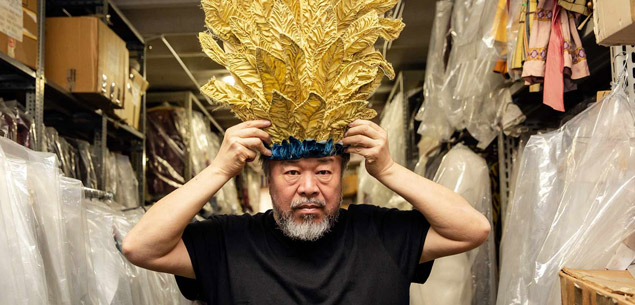

Ai Weiwei is a well-known Chinese contemporary artist and activist who has gained international fame for his thought-provoking art installations, architecture, photography, and active presence on social media. The film begins with the text ‘Everything is Art, Everything is Politics’ that’s attributed to Wei.
If you haven’t heard of Giacomo Puccini’s Turandot, it’s a story that takes place in a mythical version of Beijing. The icy Princess Turandot has declared that she’ll only marry a man who can solve three riddles, and they’d face execution if they failed. Prince Calaf, a Persian immigrant, bravely takes on the challenge to win her love at a great personal risk. Wei is a revolutionary champion of human rights and free speech who uses various forms of art as a tool to share his humanitarian message with the world. So naturally, he infuses current political commentary in his adaptation of Turandot.
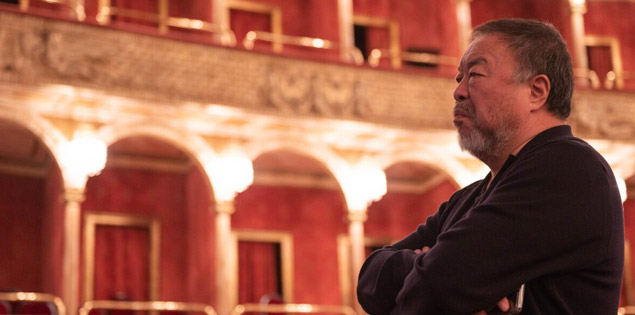
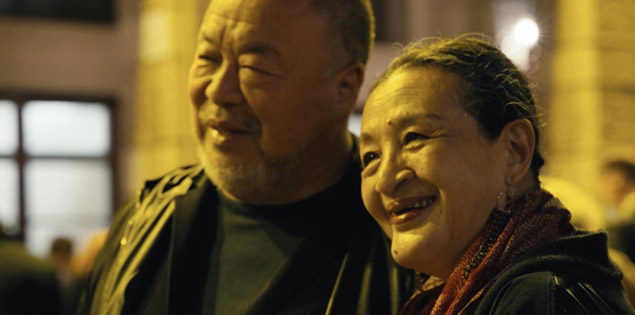
By his own admission, Wei admits he’s not a fan of opera and doesn’t even listen to music. In one part of the music rehearsal, Wei looks both bored and perhaps a bit baffled. His only connection to this theatrical art form is that he was an extra in Franco Zeffirelli’s Turandot production at NYC’s Metropolitan Opera in the mid 80s, which was choreographed by Chiang Ching. Thus, this project reunited Wei with his longtime friend, and seeing them work together is gratifying to see.
Wei comes across as a straightforward, honest, and pretty funny guy as he takes viewers on his journey on his operatic debut at Rome Opera House. ‘I like to do what I’m not good at,’ Wei admits, which could be the key to his genius, as he can approach every project with a new outlook and creative insight. It’s fun to see the behind-the-scenes of an opera production, especially one as singular as this one. It’s amusing to watch Wei documenting the process himself with his own smartphone.
Director Maxim Derevianko shows Wei interacting with the Turandot’s production team, from the set design, costumes, rehearsals, etc. I have to admit, some of the costume choices are mind-boggling. The ancient Chinese princess’s costume has a butterfly motif, while the Persian Prince Calaf has a giant frog on his back. The stage design is stunning, featuring a world map with ruins layered on top, and he also included video projections in the show.
The film also illustrates the danger of speaking out in China, as there was footage of Wei being arrested at the Beijing airport after he spoke out against the government after the 2008 Sichuan earthquake which killed 70,000 people. Wei also spoke out against the Chinese elite in regards to corruption in the school building constructions, as most of them collapsed while government structures remained intact.
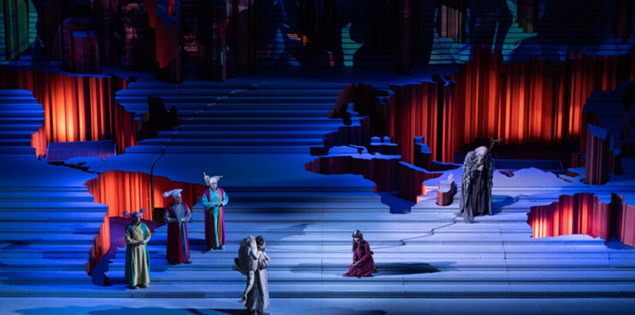
I expected that watching Ai Weiwei’s Turandot would spark my creativity, but I was taken aback by how deeply it moved me. What’s truly remarkable about this production goes beyond its unique vision and aesthetics, but the fact that it was shaped by two significant global events: the COVID pandemic and Russia’s invasion of Ukraine. The production had to be shut down for two years, something the Opera House had never done in 140 years. I mean, it overcame two world wars AND the Spanish Flu.
Due to delays caused by the pandemic, the original conductor was swapped out for Ukrainian conductor Oksana Lyniv. It’s uncanny and heartbreaking that shortly after production resumed in February 2022, Russia invaded Ukraine. It was heart-wrenching to hear Lyniv talk about her concern for her family and her country.
The film transformed into something deeper than just showcasing Wei’s creative journey; it raised questions like ‘What is art? Why is it essential?’ One interviewee pointed out that if we lived in a world devoid of sound or music, it would be hard to imagine how we could cope. It struck me how vital art is to our existence, just like the air we breathe. By the end, I teared up as the powerful aria Nessun Dorma soared on stage. This production went beyond mere entertainment; it conveyed a profound message about love, the importance of free expression, and how artists serve as warriors and advocates for what truly enriches our lives.
I love this quote from Wei that appears at the end… ‘Art competes with reality, but art will have the last word.’ Let that be so.

 FLIXCHATTER FILM BLOG
Adding it to my watchlist.
I read that it just lands a sales deal with a Berlin company specializing in docs, so hopefully this will be on streaming soon. It’s SO GOOD!!
Oh wow, I’ll have to save this to my watch list! I cant’ say I’m familiar with him, but I’m very intrigued.
I wasn’t super familiar with him either though I remember his name from the news from a few years ago. It doesn’t lessen my enjoyment as he’s an amazing artist and this project is astounding even for non-Opera fans!
Pingback: The Minnesota Movie Digest: Issue No. 136 – The Minnesota Film Critics Association
Wow! Love!
Fantastic review. It sounds like there’s a lot of grist for the mill in this docu.
I adore his quote at the end, too.
Also:
‘What is art? Why is it essential?
Two questions to ponder, but I always say – Art Remembers Us
Thanks Ruth! xx
I thought of you when I watched this Resa! I was like ‘wish I could bring Resa to see this!’ It’s such a beautiful film filled with so much creativity and Ai Weiwei is quite a funny guy too. His quotes are so spot on, I love that he said ‘art will have the last laugh!’ Even when politicians always try to ban art, it always thrives!!
Thanks for your comment as always! XOXO ❦ ♡ ♥
My pleasure!
XOXOXOXO
Pingback: MSPIFF 2025 viewing recap + mini reviews + FlixChatter’s picks of 3 Favorite #MSPIFF44 films from the past 12 days – FLIXCHATTER FILM BLOG
Pingback: Thanksgiving Weekend Special: 25 Cinematic Things I’m Thankful For in 2025 – FLIXCHATTER FILM BLOG
Pingback: FlixChatter’s Top 10 Films of 2025 + 10 Honorable Mentions – FLIXCHATTER FILM BLOG