
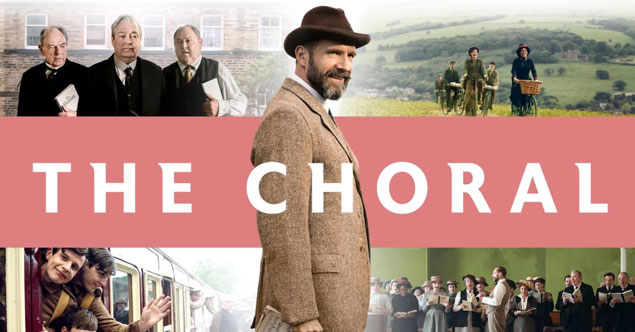
Given there is so much chaos, fear, and uncertainty facing my state right now with no end in sight, I’ve been turning to more feel-good films than usual for obvious reasons. So a movie about a choral society during WWI seems to be the calming diversion I’m looking for.
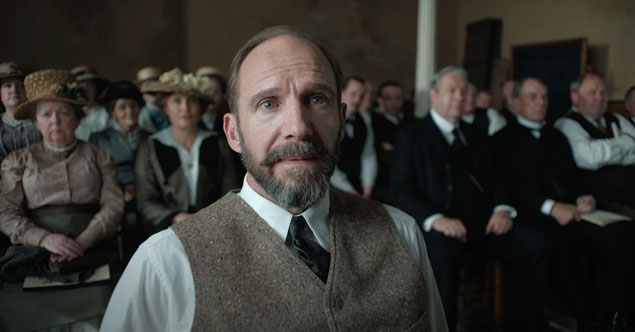
It’s the summer of 1916, and the fictional industrial town of Ramsden in Yorkshire is feeling the impact of World War I. Their choirmaster decides to join the war effort, which leaves the local choral society’s committee in a bit of a bind as they scramble to find someone to take his place. One top contender with the right musical chops is Dr. Henry Guthrie (Ralph Fiennes), a renowned conductor who has spent a lot of time working in Germany, which is Britain’s main enemy. Unsurprisingly, the locals are wary of Guthrie, especially since he’s described by one committee member as ‘not a family man.’ The film doesn’t come right out and say it, but it’s heavily suggested that Guthrie is both an atheist and gay.
At first, the selected piece was Bach’s St Matthew Passion, but Guthrie suggests we go with Edward Elgar’s The Dream of Gerontius instead. I’m not really into choral music, so I don’t catch all the details, but it’s super interesting that Guthrie knows Elgar and could actually write to him for permission to use his work. The film shines the brightest when it’s centered on Guthrie, which is basically whenever Fiennes is on screen. Sadly, the script by Stephen Beresford and Alan Bennett lacks a strong focus, making the film feel a bit aimless at times. The young boys are dealing with the reality of being drafted into the army, but their scenes come off as somewhat frivolous and even a bit whimsical.
Director Nicholas Hytner is no stranger to British historical dramas (like The History Boys and The Madness of King George), and being gay himself makes him a fitting choice to direct this story. Interestingly, though, Hytner tones down the LGBT elements to the point where it feels a bit sanitized. I’m not saying we need explicit flashback scenes of Guthrie’s past with men or anything, but even the mention of his late lover is too subtle. The choral pianist Robert Horner (Robert Emms) actually comes on to Guthrie a couple of times, but the scene is done in the most inoffensively genteel manner. Horner is the most vulnerable character in the film, as he’s a conscientious objector who also has to deal with the heartbreak of an unrequited love for Guthrie.
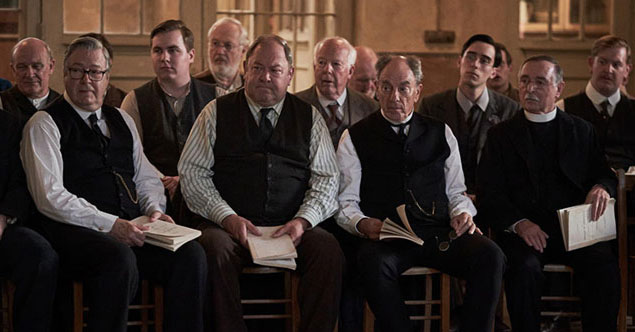
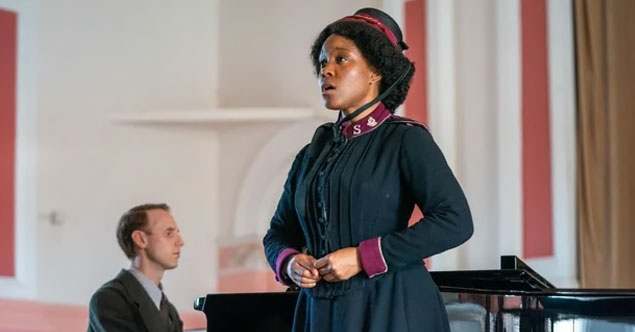
The supporting cast features a skilled group of British character actors, including Roger Allam, Mark Addy, Alun Armstrong, and Simon Russell Beale. Allam plays a mill owner who usually sings tenor in the choir, which is quite a fascinating role, while Beale’s portrayal of Elgar is more of an amusing cameo. Among the younger actors, Amara Okereke shines as Mary with her angelic voice, and Jacob Dudman is quite as a wounded soldier who gets recruited as a tenor. The star is undoubtedly Fiennes, who’s consistently excellent in everything he does. There’s a moment when he’s visibly moved by Mary’s beautiful soprano; it’s such a lovely moment, showcasing his incredibly nuanced acting.
The Choral weaves numerous smaller narratives that touch on themes like war, loss, sexuality, and class. Some characters are eager to join the war and prove their worth, while others, like Guthrie and Horner, stand against it. The harsh truths of who returns and who doesn’t are also present. However, there might be too many competing subplots, leaving each one underdeveloped. Every now and then, you catch a glimpse of something great, but there are definitely missed chances where the plot could have been better developed and fleshed out.
On a technical note, this film screams prestige drama. Shot on location in Yorkshire, the visuals are stunning and beautifully lit by cinematographer Mike Eley. I’m a fan of choral music, so I really enjoy the rehearsal scenes and the final performance at the University of Manchester. Even with some darker and more risqué themes, The Choral maintains a generally upbeat and lighthearted tone, which makes me wonder if the studio’s ‘committee’ had a hand in that. It’s surprising that it’s rated R because it feels more like a PG film, akin to a cinematic comfort food.
Overall, I think The Choral is worth checking out for those who enjoy British films and period dramas. It’s a light and entertaining way to spend an afternoon, but it doesn’t really offer much depth to leave a lasting impact.

 FLIXCHATTER FILM BLOG
This looks like a decent film as I do like some of Nicholas Hynter’s films like the highly-underrated 2000 film Center Stage featuring a young Zoe Saldana.
I’ve never heard of Center Stage but I’m curious now, I do like films about ballet. This one is still worth a watch; I need more feel-good movies during this scary, chaotic time.
It is a better film than it had any right to be. It is just downright entertaining. It was marketed as a teen ballet film which got it all wrong. It was way better than that. Especially the last dance number. I’m kinda surprised that it has this cult following that continues to grow.
Excellent reviews as always. “The Choral” is a movie I have never heard of until now but your review has given me a reason to check it out. I have always been a huge fan of Ralph Fiennes who is currently one of my favourite actors working today. He is a truly extraordinary actor that has proven he can play a diverse range of characters in unforgettable movies. I love all his movies but “Schindler’s List” is truly my personal favourite. Besides, I also love old-fashioned British period dramas. So, this does seem like the kind of movie that’s tailor-made for me. Even if it isn’t a masterpiece, I have a feeling I will enjoy it. I will definitely check this one out.
Here’s a list of my favourite Ralph Fiennes films:
This one is definitely worth watching because of Ralph Fiennes. I wish he’d been given something meatier to chew on, but still, his acting is top-notch. If you like old-fashioned British dramas, then this one is for you!
Great list btw, his role in Conclave should’ve earned him an Oscar! If you love Ralph, you have got to check out A Bigger Splash as his performance is also amazing https://flixchatter.net/2016/06/06/flixchatter-review-a-bigger-splash-2016/
Thanks for the feedback. As a big fan of Ralph Fiennes, I will definitely check this out. I’ve always been a huge fan of the actor ever since I first saw him in “Schindler’s List”. I am still shocked that he hasn’t won an Oscar. He’s definitely one of the most underrated actors in Hollywood today.
I actually saw “A Bigger Splash” many years ago. I don’t remember the story clearly but I do recall being impressed with Fiennes’ performance.
Here’s my thoughts on “A Bigger Splash”:
Oh glad that you have seen that movie, Ralph is so fun to watch there, amazing how he could embody SO MANY varied personalities. Great review, Hassan!
Thanks for the kind words. As always, I appreciate your positive feedback. Ralph Fiennes is a truly incredible actor that has proven he can make great films in every single genre. A Bigger Splash is one of his lesser known works but still a great reminder of his talents as an actor. I am very interested in seeing the new 28 Years Later sequel now in theatres. He is a great actor that never makes bad movies.
Pingback: FlixChatter’s JANUARY 2026 Viewing Recap, Mini Reviews of The Wrecking Crew & Secret Mall Apartment, and Movie(s) of the Month – FLIXCHATTER FILM BLOG
Pingback: The Minnesota Movie Digest: No. 174 – Minnesota Film Critics Association
Ruth,
Yes, lighter films make sense with all that is happening in your city.
Although, here, there and everywhere is a tough time with so many humans all so fractured with ideas, opinions, conceptions, misconceptions, and on…BUT mostly the inability of people to live together in harmony and respect.
This movie sounds okay, but it’s a maybe..if I comes across it one day.
xoxoxoxoxo