
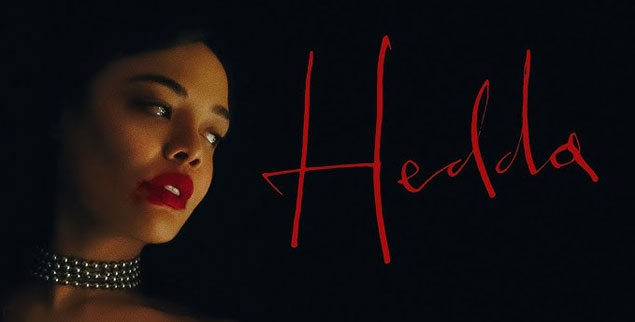
Hedda is a pretty loose adaptation of Henrik Ibsen’s play from the 1870s. Nia DaCosta takes Ibsen’s themes and gives them a sumptuous and feminist twist while making some notable changes to the plot. One clear change is the setting, which shifts from 19th-century Norway, representing the white European bourgeoisie, to 1950s England featuring a racially diverse cast.
In this adaptation, Hedda is biracial, but she is still the daughter of a general with a tumultuous history, trapped in a stifling marriage to an academic named George Tesman (Tom Bateman). Tessa Thompson is resplendent in the lead role, embodying a passionate, cunning, and alluring woman who captivates everyone around her. We learn through remarks from other characters, notably the powerful Judge Brack (Nicholas Pinnock), that Hedda is an illegitimate daughter, which makes her feel insecure and longs for control. Brack constantly points out how her identity is linked to her deceased father, rather than her own achievements.
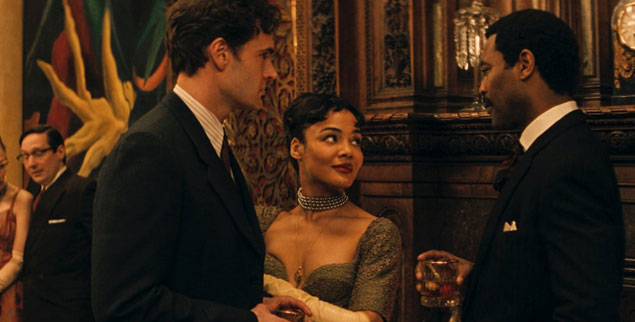
The first time we encounter her, she’s donned in a striking red dress that perfectly complements her crimson lipstick, casually firing shots with the pistol gifted by her late father. She appears distinctly uninterested in her current life as George immerses himself in his academic pursuits and vies for a professorship. The Tesmans are living far beyond their financial means; in fact, they are spending money they do not have.
They reside in a lavish manor, primarily funded by Brack, and are staging a lavish soirée for their bourgeois circle of friends. Throughout one intense night, long-buried desires and concealed tensions explode—drawing her and those around her into a whirlwind of manipulation, passion, and betrayal.
DaCosta crafts a lavish visual experience for Hedda’s world. The film was filmed at Flintham Hall, an Italianate manor house located near Newark in Nottinghamshire. Cinematographer Sean Bobbitt expertly captures the landscape, and the lighting is simply exquisite. The visuals shine even brighter as night falls, creating a wonderfully atmospheric ambiance, enhanced by Hildur Guðnadóttir’s eerie and evocative score.
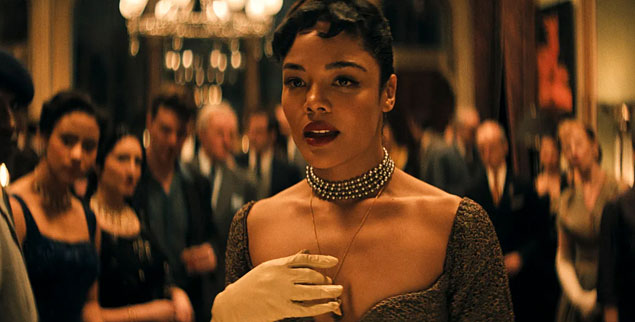
The mood is evocative in that you can sense Hedda’s feeling of being trapped, both by circumstances and her own ambition. Lindsay Pugh‘s costume design is stunning, and it helps us understand the characters. Hedda’s jade party dress with its structured boning, accessorized with a pearl choker, feels like it suffocates her. It speaks volumes that she keeps the chain necklace, which contains the key to her gun box, close to her heart.
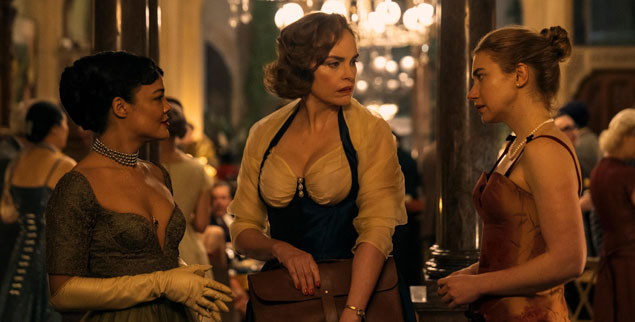
The arrival of Hedda’s former lover and George’s academic rival, Eileen Løvborg (Nina Hoss), adds extra tension to the festivities, especially since Hedda fails to mention to George about inviting her. The gender swap from male character (Eilert) to female adds that element of taboo, which the film doesn’t shy away from. Eileen has her own agenda as she is pitching her bold new book about the future of sex to Professor Greenwood (Finbar Lynch), as she is competing for the same professorship as George.
As the night wears on, Hedda’s jealousy towards Thea (Imogen Poots), Eileen’s new lover, who’s helping her overcome her wild past, spirals even further out of control. Thompson clearly relishes playing the Machiavellian siren, so ruthless that she’d nonchalantly hand a glass of martini to a recovering alcoholic. There’s a moment with Eileen that makes everyone in the theater practically gasp. That scene really highlights the power struggle between the two women while also commenting on Eileen’s experience as a woman in a male-dominated academic setting. Hoss shines here as a brilliant yet emotionally unstable character, and her desperation towards the end is so palpable. I’ve only seen her in Phoenix and Tár, but I’d love to see the German actress take on more prominent roles.
I read that DaCosta intentionally places the film right after WWII, when the aftermath of the war was still fresh in Britain. It’s a period of change where people are striving to return to the societal norms of the past, and that decade creates a tense environment that amplifies the action. If I have one quibble, it’d be the casting of Pinnock. I feel that he lacks the menace or gravitas required for such a powerful man, which makes his salacious behavior towards the end seem out of character. I also think the use of the ‘devil’s whisper’ sound every time something bad is about to happen feels a bit on the nose.
That said, this is a remarkable work by DaCosta. She keeps the ending open-ended, and it’s actually less grim than the original play. Her fourth feature marks her third collaboration with Thompson; they clearly have a great rapport. With DaCosta’s directing skills and Thompson’s exceptional acting talent, this partnership proves to be another successful one.

HEDDA is now streaming on Amazon Prime
 FLIXCHATTER FILM BLOG
I’ve heard good things about this film as well as praise for Tessa Thompson who does deserve more attention. I’ve only seen The Marvels from Nia DaCosta as I’m in the minority about that film as I liked it a lot. I saw a thing from Letterboxd on YouTube where Thompson and DaCosta were talking about the film and the things they wanted to do differently.
I saw a trailer of this movie a while back but I didn’t know when it was coming out. It looks interesting, not sure if it’s something I would watch. I have not seen any of DaCosta’s work but I’m looking forward to 28 Years Later: The Bone Temple. I do like Tessa Thompson, so I might watch this one someday.
Hedda sounds like a good one to watch. Alas, I don’t have Prime.
Well, if it’s as good as you make it sound, especially in the costumes department, I will be watching when Nom season happens, and I get my platform viewing codes!
That’s if it’s considered for a TV award, and not a film award.
Thanks Ruth!
Pingback: FlixChatter’s OCTOBER Viewing Recap + ’52 Films By Women’ Update + Movie of the Month – FLIXCHATTER FILM BLOG
Pingback: The Minnesota Movie Digest: Issue No. 164 – Minnesota Film Critics Association
Pingback: Happy New Year! FlixChatter’s 10 Favorite Music Scores + Soundtracks of 2025 – FLIXCHATTER FILM BLOG