
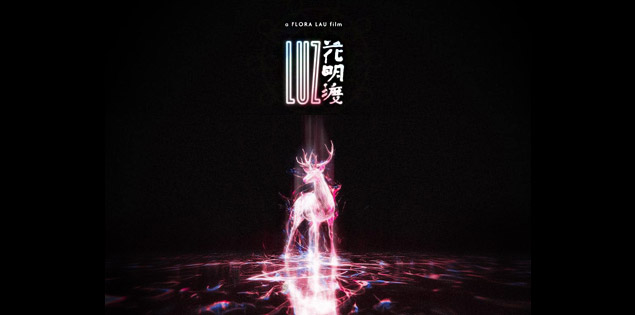

Luz is a fascinating exploration of connection with the use of technology, notably virtual reality, as characters living on two different continents collide in a VR world. It opens with a mythical translucent deer strolling the street of an LED-lit modern city. These fascinating and mysterious visuals are what fuel Flora Lau’s second feature, which decidedly feels experimental in its approach. It leaves me wondering just what the deer signifies as we meet the main players in these parallel storylines.
In Chongqing, Wei (Xiao Dong Guo) is on a frantic quest to find his daughter Fa, while in Paris, Ren (Sandrine Pinna) is trying to reconnect with her stepmother Sabine (Isabelle Huppert). We witness Wei and his brother pulling a night shift for their nightclub-owner boss, and during breaks and free moments, Wei is glued to a live stream featuring a young girl. Although the girl’s identity is fairly easy to figure out, the film takes its time revealing the connection.
When Wei can’t get through to Fa using the stream’s chat, he decides to search for her in the VR game Twilight Forest, where participants hunt the deer. This game is inspired by a painting created by Ren’s late father, a renowned artist who was previously married to Sabine. Ren frequently plays the game, too, and the film alternates between the game world and real life, using cool visual transitions between the two different realities. Lau’s use of a bold color scheme connects the different realms so well that it often blurs the line between reality and illusion.

Wei’s desire to reconnect with his daughter is evident, but I feel that the dynamic between Sabine and Ren lacks emotional depth. Pinna is beautiful but often expressionless, particularly in some of the touching moments that could have been more impactful. On the other hand, Sabine’s joie de vivre is electrifying; she’s a woman who won’t let her illness control her life. Huppert is the primary reason I wanted to watch this, and she certainly delivers. I also find it fascinating to see that Ren and Sabine are able to communicate in two different languages, Mandarin and French, seamlessly.
The stunning visuals with such vibrant hues, plus the clever use of music and camera angles, are a treat to see, but it seems to overcompensate for the superficial story. I wish Ren and Sabine’s relationship had been explored with more depth, but Lau seems more concerned with the eye-candy effects. Some of the scenes are interesting but leave me pondering their significance.

That mystical deer in the painting remains a mystery, and I’m not sure what that whole painting forgery relates to the story. That bit actually takes me out of the movie a bit, as it made me think of a documentary on Netflix about fake art. There’s also a rather strange but captivating dance scene at Sabine’s gallery that makes me think LUZ might work better as a visual installation at a museum or a short film than a narrative feature.
While it has its flaws, I’m still impressed and quite entertained by LUZ, and I’m glad I got to enjoy it on the big screen. Lau is a talented and creative filmmaker, so I’m looking forward to her next project, hoping it strikes a better balance between a compelling story and stunning visuals.

 FLIXCHATTER FILM BLOG
I’ll check it out when it arrives on streaming. I love Isabelle Huppert.
Yeah me too! Huppert is always lovely even in a so-so movie.
Pingback: The Minnesota Movie Digest: Issue No. 136 – The Minnesota Film Critics Association
Pingback: MSPIFF 2025 viewing recap + mini reviews + FlixChatter’s picks of 3 Favorite #MSPIFF44 films from the past 12 days – FLIXCHATTER FILM BLOG
Hmm, it does sound like an installation.
Still, it sounds innovating.
Yet, I don’t feel moved to watch this.
Thanks for the review, Ruth! xx
It’s a gorgeous movie but yeah, not as emotionally fulfilling. Still I’m glad I saw it, Isabelle Huppert is a treasure!