
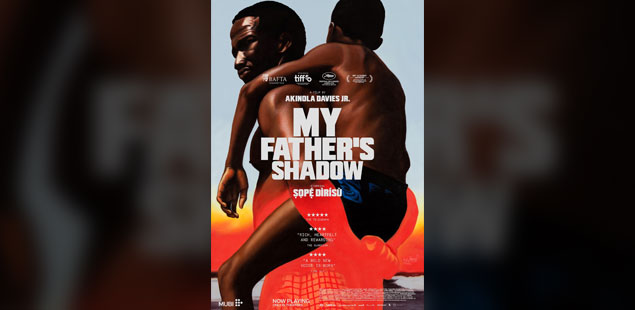
Ah, the wonderful world of cinema… it lets me vicariously explore places I’ve never been to. Just last week, with The President’s Cake, I found myself in Baghdad, Iraq, and this time, My Father’s Shadow took me to Lagos, Nigeria, during the 1993 national election.
The movie kicks off with two young brothers, 11-year-old Remi and 8-year-old Akin, having fun in their front yard in a rural Nigerian village. It’s already pretty hot, even in the sunny morning, and the boys are keeping themselves entertained with homemade paper wrestling figures and some playful, competitive teasing. Their parents are nowhere in sight, creating a feeling of isolation and restlessness in their absence. The mood suddenly shifts when their dad, Folari (Sope Dirisu), unexpectedly shows up at home. Folari is mostly absent, usually working in the city to support them. To the boys, he seems almost like an imaginary figure, judging by their astonishment at his sudden appearance.
Folarin tells the guys he needs to head back to Lagos to grab a paycheck that’s been long overdue. When one of the boys expresses how they hardly get to hang out with him, Folarin suddenly decides to take them along on his trip to the city. Writer/director Akinola Davies Jr. paints a vivid picture of the stark difference between the calm village life and the chaotic energy of Lagos, which they reach after taking various modes of transport, including a broken-down bus and a ride in a stranger’s pick-up truck. When Folarin protects his boys before they cross the street, it reminds me of the wild traffic in Jakarta, where I grew up.
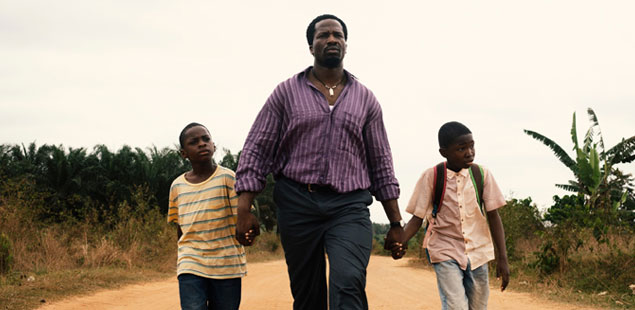
While they’re in the city, the boys observe their dad interacting with his friends and associates, who refer to him as “Kapo,” meaning ‘boss’ in their circle. We discover alongside Remi and Akin just who their father really is. It turns out he’s a dedicated factory worker who hasn’t received a paycheck in months, just like his coworkers. Through conversations and news on TV, we also find out that Folarin is a big supporter of M.K.O. Abiola, who ran for president against a military leader. This election is historic, and Abiola’s victory would mark a significant change from military rule to democracy.
Davies Jr. teamed up with his brother Wale Davies to co-write the script, which is based on their own life experiences. The Davies brothers paint a compelling picture of a family in crisis, set against a backdrop of a nation in political upheaval. The film unfolds over a single pivotal day, packed with symbolism that reminds me of On Becoming a Guinea Fowl, which was set in Zambia.
The recurring imagery of ominous birds flying overhead and the unexpected reactions whenever someone meets Florian suggest a supernatural element at play. We also see glimpses of the boys’ mother (Wini Efon) dressed in mourning clothes, along with unsettling shots of soldiers in convoy vehicles staring at them. The Bonny Camp military base is frequently mentioned in the film, alluding to a horrific massacre that occurred after the election was annulled. It appears that Florian experiences a nosebleed every time that camp is brought up. At one point, a soldier recognizes Florian, and the script implies that he didn’t survive that incident.
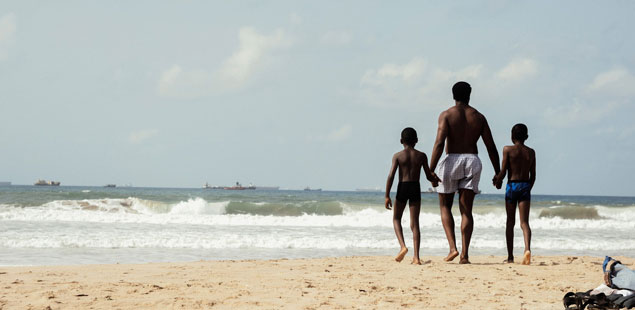
This film is truly a brotherly collaboration since the two characters are portrayed by actual brothers, Godwin Chiemerie Egbo (Akin) and Chibuike Marvellous Egbo (Remi). They’re both newcomers to acting, which gives their performances a refreshing and organic feel. The standout moments happen when they interact with their estranged father, showcasing a wonderful chemistry with Dirisu. I love the scenes of the three frolicking in the ocean, which remind me of the pivotal scene in Moonlight, which also features a father-son relationship, albeit a surrogate one.
British-Nigerian Sope Dirisu is absolutely magnetic in the lead role. Most people might know him in Gangs of London series or his appearance in season 3 of Slow Horses. He first caught my eye in a supporting role in Mothering Sunday back in 2022, and then again in his lead role in the Jane Austen-inspired rom-com Mr. Malcolm’s List that same year. He’s memorable in every role he’s done, and he cuts a mesmerizing figure in this one, displaying raw masculinity and genuine tenderness. The London-born actor took special training to speak with a Nigerian, specifically Yoruban, accent, which sounds pretty authentic.
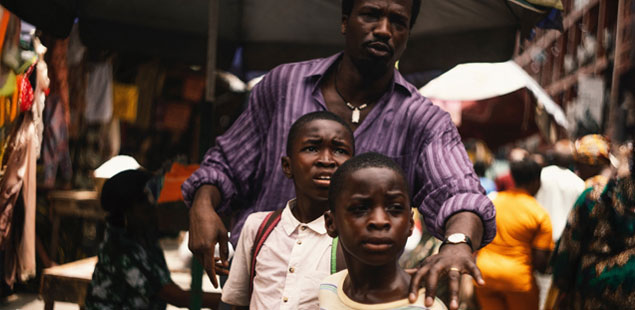
Folarin gradually opens up to his sons during their journey. He confides that he once feared the water because his brother drowned, and he recounts a tale about his brother’s fear of being forgotten. It feels like a subtle indication of Florian’s destiny, almost as if he’s bidding farewell to his sons. As someone who grew up without a father, this moment really resonates with me, especially when Akin asks, “Daddy, if you say that you love us and God loves us, does that mean that people who love us are always far away?” Glad I had tissues handy.
This is an astounding directorial debut that’s wonderfully atmospheric and immersive, with a sense of mystery throughout. The direction is gentle yet stylistic and edgy, as Davies Jr. seems to have drawn on his experience as a music/fashion video and commercial director. The cinematography by Jermaine Canute Edwards is intimate and uses close-ups effectively to capture Folarin’s deep longing and sadness, while the two boys shift between curiosity and wonder.
My Father’s Shadow ranks as one of the best films that takes place over a single day. It’s an indelible and poetic homage to an absent father and a once beleaguered nation.
Now playing in select theaters and will be streaming on MUBI

 FLIXCHATTER FILM BLOG
I have this on my watchlist as I know it will arrive on MUBI sometime later in the year since its main distributor is MUBI.
Yeah, it’s distributed by MUBI so it’ll be streaming there at some point. I’m glad it’s got a theatrical release, though it’s yet to play here in MN. I saw this on a screener.
I’ve never heard of this one before but Sope Dirisu is a great actor and I’m shocked that he hasn’t breakout here in the States yet. With all these Hollywood action stars are in their 50s, 60s and 70s now, he would great to pick up the mantle. He’s great in Gangs of London even the quality of the show has been up and down.
I hope Dirisu will get a big Hollywood role soon, he’d make a great action star that can do dramatic roles. I see him as the next Denzel if he plays his cards right. He’s very charismatic and obviously very talented.
Pingback: 10 Highly-Anticipated 2026 Films Directed By Women – in honor of International Women’s Day – FLIXCHATTER FILM BLOG
Pingback: The Minnesota Movie Digest: Issue No. 179 – Minnesota Film Critics Association
Wow!
It’s hard to find a decent hanky movie these days.
I like this idea of travelling the world through film. It’s not just the locations, but ways of life, history and thought process.
This sounds a worthy film to watch.
❦💙❦xoxoxoxo
I find that international films (that is, non-English language films) often offer more depth than Hollywood fare. You’re right that the exploration of life, history, culture, etc., is just as fascinating as seeing the scenery of a particular country.
XOXOXO ♥︎ · 𑣲 · ᢉ𐭩 ·· ❤︎ · ❦
Yes!
xoxo ❦💙❦❦💙❦ xoxo