
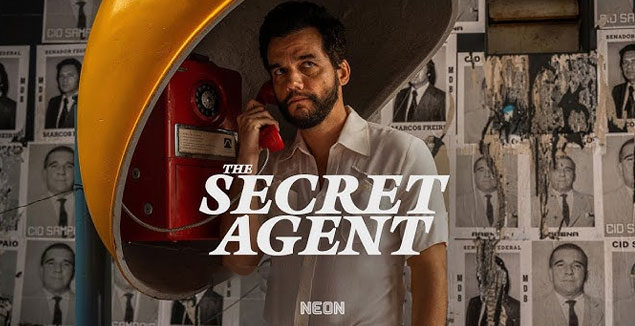
When I first saw the trailer of The Secret Agent, I immediately thought of I’m Still Here, one of my favorite films of 2024, as both deal with the country’s 2-decade military dictatorship. But that’s pretty much where the similarities end, as they vary greatly in terms of tone, style, and messages. Written and directed by Kleber Mendonça Filho, the title is quite ironic because the main character, Armando (Wagner Moura), is a former science professor rather than a glamorous spy, even though he goes by the alias Marcelo while he’s on the run.
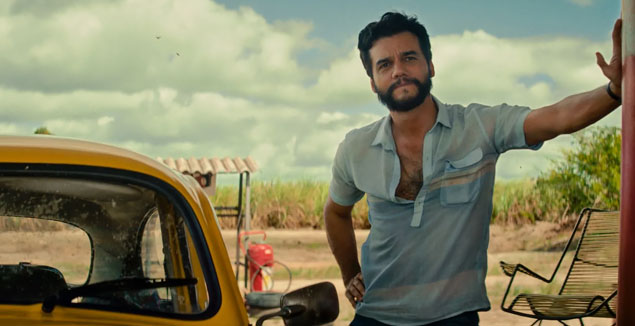
Set in 1977, Filho takes us on a journey to experience life under a military dictatorship. We meet Armando in his yellow VW Beetle as he stops for gas on his way to his hometown, Recife, during the carnival holiday. A decaying dead body sloppily covered by cardboard has been lying there for days, as it’s not uncommon that people ‘disappear’ during this repressive ‘period of mischief.’ When the cops show up, they completely ignore the corpse and instead start interrogating Armando, asking for a bribe for the ‘Carnival fund.’ Right from the beginning, there’s this unsettling and ominous vibe, but it’s also mixed with absurd humor, like the hairy leg found in a dead shark’s belly (a nod to the filmmaker’s love for Spielberg’s JAWS). Apparently, the ‘hairy leg’ is an urban legend that journalists use as a coded term for state-sanctioned violence against marginalized communities.
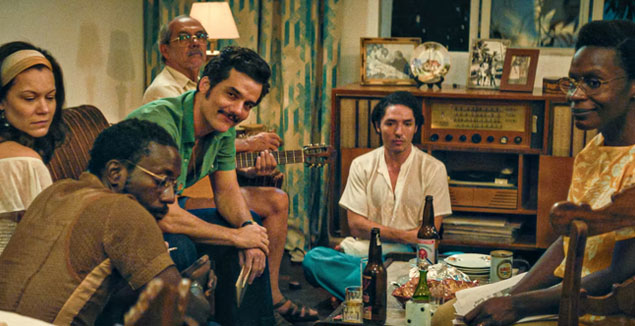
Armando seeks shelter with the formidable, exuberant Dona Sebastiana (Tânia Maria), alongside other political refugees, as he plans to escape the country with his son Fernando (Enzo Nunes), who is being raised by his grandfather Alexandre (Carlos Francisco).. The reason for Armando’s flight isn’t revealed until past the halfway mark of its nearly 3-hour runtime, but we can only speculate that he’s made enemies with a crooked, powerful federal official. A flashback scene depicts Armando with his clean-energy research team at the university and his encounter with Ghirotti (Luciano Chirolli), who shuts down his department. The whole ordeal hints that his young wife, Fátima (Alice Carvalho), may not have passed away from natural causes. As I grew up during Indonesia’s dictatorship under Suharto that lasted three decades, I knew a little bit of what that’s like. We couldn’t say anything negative about Suharto for fear of repercussions, whose photos hung prominently on the walls of public office, just like Brazil’s then-president, Ernesto Geisel.
Filho blends political thriller elements with B-movie surrealism, featuring a hairy leg that later shows up attacking gay men in a park, and Dona’s mellow, two-faced cat. The film is mostly wrapped in mystery, with a slow pace that lets us soak in the humid atmosphere and feel the city’s rhythm and texture. There’s even a festive and colorful Carnival scene on the streets that Armando takes part in briefly. That sense of joy is fleeting as there’s an overwhelming sense of paranoia looming, making every ordinary person seem like they’re under constant surveillance.
Charismatic Brazilian actor Wagner Moura has such a magnetic screen presence that you can’t take your eyes off him, even when he’s just doing the most ordinary things. I’d say he’s suave enough that he’d make a good Latino James Bond. The movie is packed with eccentric characters that contribute to its lively world-building, from the arrogant, corrupt police chief Euclides (Robério Diógenes) to a Holocaust survivor named Hans (Udo Kier in his last film role) who faces harassment from Euclides and his privileged offspring.

The action really ramps up in the third act, where the spy thriller elements come into play: hitmen stalking their targets, surveillance, secret messages, and a race against the clock. Filho also delivers a dual narrative, connecting the past and present through Flavia (Laura Lufési), a contemporary history student who listens to audio recordings to piece together the history of the resistance network. We discover Armando’s fate through Flavia’s research, and there’s even a dialogue between her and Fernando, who is now a doctor at a blood bank. I really admire how Filho approaches this, steering clear of sensational violence and instead emphasizing the significance of memory as Fernando uncovers more about his father through Flavia.
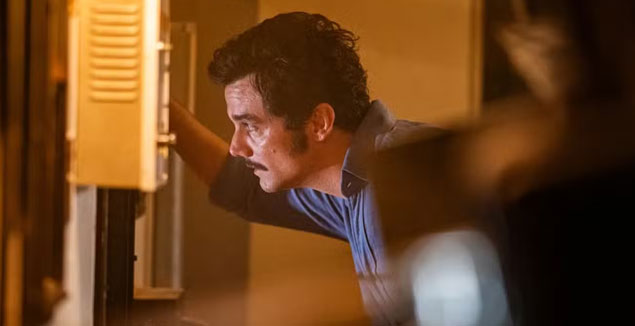
The Secret Agent vividly transports viewers to the coastal town of Recife in the 70s, thanks to its warm, vintage, and brightly-saturated color scheme. Filmed on location in Brazil with Panavision anamorphic lenses by Russian-born cinematographer Evgenia Alexandrova, the dynamic camera work captures the moody, Neo-noir vibe perfectly. The retro soundtrack is also a standout, with an original score by Mateus Alves & Tomaz Alves Souza that blends nostalgic tunes from the era, including hits from Donna Summer and Chicago. It’s no wonder this film was the top winner at this year’s Cannes Film Festival, snagging the directing award for Filho and the Best Actor award for Moura.
This is my intro to Mendonça Filho, whose bizarre yet brilliant work will likely garner more accolades all the way to the Oscars. I’ve only seen Moura in supporting roles, but he’s definitely got leading man charisma that shines in his restrained approach. I sure hope to see more of him in prominent roles in the future. Ultimately, The Secret Agent is a remarkable and one-of-a-kind movie that won’t fit neatly into just one genre. With its humanist values at its core, it’s a film that sticks with me as I reflect on the weight of the past and the elusive nature of memory.

 FLIXCHATTER FILM BLOG
This is a film that I want to see as I have become interested in Brazilian cinema as I just saw a video from Letterboxd’s YouTube channel where 2 filmmakers made a list of Brazilian films that are essential. I’m glad the cinema there is still strong despite the political turmoil they’re going through.
Yeah, two excellent Brazilian films are up for major awards two years in a row. It’s worth seeking out and I hope you get to see it soon!
A very well-written review. I have never heard about this movie but your review has definitely given me a reason to check it out. Recently, I have become a big fan of Brazilian Cinema. You mentioned “I’m Still Here” as a comparison. That was a masterpiece and one of my favourite movies of 2024. Walter Salles made a beautiful tribute to the time period when Brazil faced a war. Fernanda Torres was extraordinary, giving one of the best performances I have ever seen. Even if this film differs in its style, I will definitely check it out. Brazilian Cinema never lets me down.
Here’s my personal thoughts on “I’m Still Here”:
I’m in agreement with you about I’m Still Here and Fernanda Torres. I love that film, but this one is excellent as well, albeit very different in style and tone. I do think both directors made a wonderful tribute to their country. Wagner Moura is fantastic in a restrained performance.
I saw the trailer of this one a while back and I look forward to watching it once it comes out on streaming services. I first saw Wagner Moura as Pablo Escobar in Narcos and he was fantastic. The show also introduced me to Pedro Pascal and I thought both of them would be very successful once they get more roles in Hollywood production. Of course, Pascal has been very successful. While Moura hasn’t been as lucky. He was good in last year’s Civil War as the second lead. Hopefully, he’ll get more roles down the road.
Hey Ted, I was thinking about Pedro Pascal when I watched this… Moura reminded me a bit of the Chilean actor. I think both are very easy on the eyes and charismatic. I’m not sure why Moura hasn’t hit it big like Pascal but it could be a personal choice; not every actor enjoys being on the spotlight like Pascal. Plus Moura is not on social media, I think I read that he wants to protect himself from the “madness” and vanity which I think is very wise of him.
Pingback: 2025 Film-Watching Year in Review (via Letterboxd) + MNFCA Award Winners – FLIXCHATTER FILM BLOG
Sounds great! Will be on Netflix here soon, apparently.
Thanks for the fab review, Ruth!
XOXOXO ~❦ ~ ❀✾❀ ♥︎ ❀✾❀ ~ ❦~
Oh it’s gonna be on Netflix soon, that’s awesome!! Yeah, watch it, Resa, I think you’ll like it even though there are some bizarre parts.
Cheers!! XOXOXO
❀⋆˚✿˖° 𐙚° ⊹ ° ♡° ❀° ❦
Pingback: FlixChatter’s Top 10 Films of 2025 + 10 Honorable Mentions – FLIXCHATTER FILM BLOG
Pingback: The Minnesota Movie Digest: Issue No. 172 – Minnesota Film Critics Association
Pingback: 98th Academy Awards – Final Predictions of 2026 Oscars, Fun Trivia and Historic Firsts – FLIXCHATTER FILM BLOG