
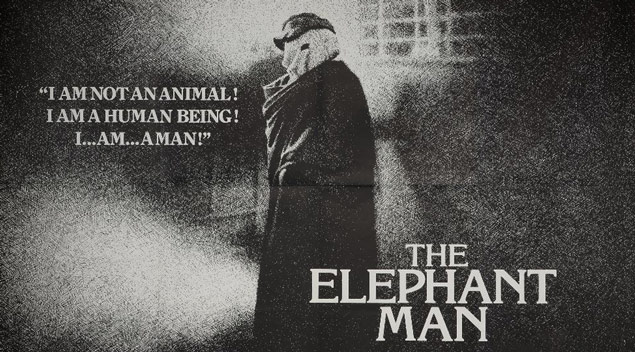
David Lynch passed away on January 15th, five days before his birthday when he would have turned 79. I have a big blindspot on Mr. Lynch, though I saw Blue Velvet when I was perhaps too young to see such a film and watched the Twin Peaks series back in the 90s. So the day after his passing, I went to a local library and checked out The Elephant Man, thankfully they got the Criterion Collection!
I caught A Different Man a couple of months back, and some film critics are saying it took a lot of cues from this film to the extent that it feels like a modern take on it. The main characters in both films, in this case John Merrick, suffer from Neurofibromatosis, a genetic condition where tumors grow in the nervous system and skin. However, aside from that, the movies are quite different from each other.
Set in 19th Century Victorian England and filmed in black-and-white, The Elephant Man opens with a rather surrealistic dream-like sequence of a woman seemingly being attacked by elephants. It’s heavily implied that the elephant encounter is responsible for Merrick’s disorder. The movie then takes viewers to a circus where a ringmaster named Bytes (Freddie Jones) is promoting a show called The Elephant Man. Merrick became an ‘exhibit’ as the only way he could earn a living, but Bytes abuses him constantly, berating and beating him up with a stick like an animal. Lynch kept John’s appearance hidden under a burlap sack with a small hole where his eyes are and a floor-length cloak.
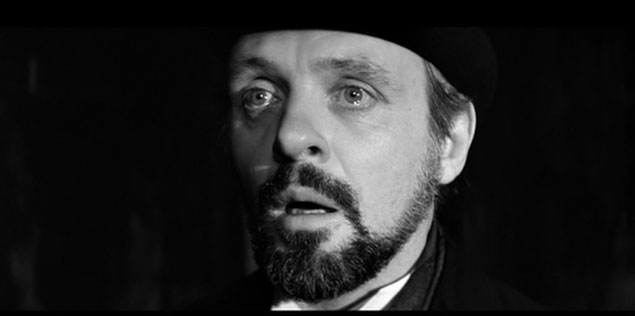
The moment Dr. Frederick Treves (Anthony Hopkins) first laid eyes on Merrick is quite dramatic as Hopkins stood there transfixed with his eyes swelling up with tears. Hopkins has never delivered a bad performance, this is definitely one of his memorable ones from his earlier work (he was in his early 40s). Treves really comes off as a guy who has a lot of empathy, but the script shows that he’s also looking out for his own interests when it comes to Merrick. He wants to write a paper for the Pathological Society to boost his standing in the medical field.
Written by Christopher De Vore, and Eric Bergren, with Lynch also credited as a screenwriter, The Elephant Man is said to be one of Lynch’s most accessible and straightforward films. That’s true narratively speaking though there are still some bizarre elements. Apparently, Paramount Pictures wanted to cut the opening and closing sequences but I’m glad they left that in. I wouldn’t say this is a weird film at all, it sure is heartbreaking though. John Hurt’s performance as Merrick is incredible and he endured so much filming this under that heavy makeup. I read that Hurt worked alternate days because the make-up was so taxing.
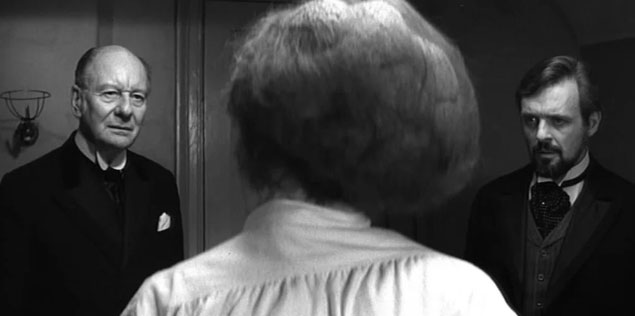
I love Hurt’s performance and there are so many memorable moments that stay with me. One in particular is the scene where Merrick surprised Treves and hospital governor Francis Carr Gomm (John Gielgud) the entire 23rd Psalm verse even though Treves only taught him part of it. It’s a turning point for Merrick as people began to see he’s an intelligent, sensitive, and sophisticated man, and that his own mother had taught him that verse.
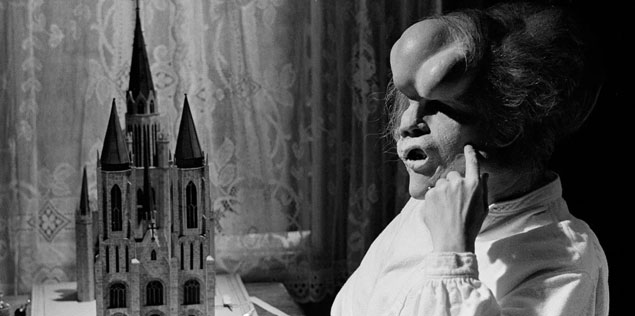
I appreciate that the film did not sidestep the deep spirituality, specifically Christianity aspects of the story. Merrick passes his alone time in the hospital by crafting a paper model of the cathedral he can see from his window, just the top of the steeple peeking through. He has to rely on his imagination to fill in the rest of the church. This process symbolizes a spiritual transformation of sort, as his faith deepens when others begin to see him as God does—worthy and loved, regardless of his appearance.
Treves is depicted as a devoutly Christian doctor, but even he has doubts about his own motives about Merrick. He asks his wife if he’s a good man because by placing Merrick under hospital care, he becomes an object of curiosity to high society. It’s quite interesting to see head nurse Mrs. Mothershead (Wendy Hiller) who’s initially a bit harsh towards Merrick has a change of heart about him and begins to care about his well being.
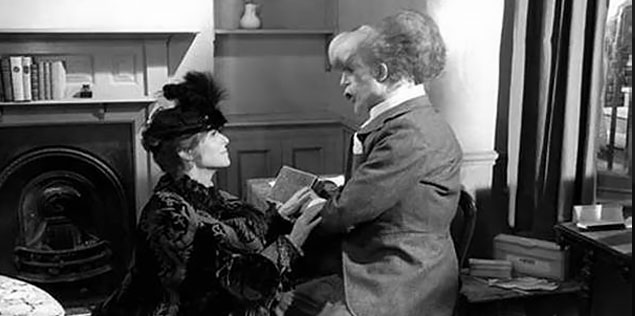
Watching the film proves to be quite an emotional roller coaster. We initially see him at his lowest point with Bytes, but the toughest part to watch is when an unscrupulous, greedy hospital night porter, Jim, brings in people to stare at Merrick, turning it into a wild spectacle. Famed theatre actress Madge Kendal (Anne Bancroft) brings such joy to Merrick when she visits him and they recite Romeo & Juliet together. For the first time, a woman makes Merrick feel like he’s worthy of love and restores his sense of dignity. The scene at the Liverpool train station is one of the film’s standout scenes, packed with tension that culminates in a truly heartbreaking moment. Merrick finds himself pursued, exposed, and trapped by a furious crowd. Just before he falls, he shouts, “I am not an elephant! I am not an animal! I am a human being! I am a man!”
What I didn’t realize is the story is loosely based on a real person with severe deformity named Joseph Merrick. The script does take liberty with its chronological order and some details about Merrick’s story. It’s interesting to learn that Mel Brooks is one of the film’s producers, though he was not credited as he feared people would wrongly assume the movie is a comedy. Apparently Brooks couldn’t secure the rights to the stage adaptation, so he based the film on the memoirs of Frederick Treves and a later biography of Merrick by Ashley Montagu. Brooks took a chance on the then relatively unknown Lynch after being impressed with his directing of Eraserhead.
From a technical standpoint, this film is a thing of beauty. The realistic makeup of the protagonist, crafted by Christopher Tucker, plays a key role here. It was made using casts of Joseph Merrick’s body, which are housed in the private museum of the Royal London Hospital. Stuart Craig‘s setting and production design are absolutely breathtaking; the 1980 film feels like it was shot in the late 1800s. Craig and cinematographer Freddie Francis did an amazing job bringing the slums of England to life, capturing that moody atmosphere with a thick fog. In the DVD extras, Lynch mentions that there were still quite a few Victorian buildings around during filming, but sadly, many of them have since been torn down. I love the score by John Morris and the use of Samuel Barber’s piercingly beautiful Adagio for Strings in the finale.
I love The Elephant Man and it’s a timeless classic I know I will remember for a long time. I wish I had seen it sooner but it’s better late than never. My main takeaway is that the real horror of humanity isn’t about how we look on the outside, but rather the darkness that can exist within our hearts. I plan to check out more of Lynch’s works but surely this one would be the one to beat as my favorite.

Have you seen The Elephant Man? I’d love to hear what you think!
///
 FLIXCHATTER FILM BLOG
I saw The Elephant Man years ago. I like Lynch’s work, even when I don’t like it.
I liked Twin Peaks when it came out, but got bored after 4/5 episodes.
The Elephant Man is a wonderful film, so well done and an important story. However, I only need to see it once. Same with Blue Velvet.
There are many films that are excellent, but I will never watch again. Once is enough.
One film that is very well done and memorable, but I never want to see again is In Cold Blood by Truman Capote.
David Lynch was a terrific film maker. RIP Mr. Lynch
Thanks for the review, Ruth!
Hi Resa! I don’t remember much about Twin Peaks as it was ages ago when I saw some of the episodes, but what I recall is how beautiful Lara Flynn Boyle was.
True that Blue Velvet is a one-time-watch only but I can see myself watching The Elephant Man again. I’m a big fan of period pieces and the story + visuals are so beautiful, John Merrick’s story really moved me, more so than I expected.
I had to look up In Cold Blood, ugh it sounds disturbing. One of the actors, John Forysthe, is from the famous Dynasty series, that was huge back in the 80s back in Indonesia.
YES, Lara was a beauty! She’s a wreck now.
I loved Dynasty!
The movie, ICB, is well done, the acting sublime and it got a lot of kudos, but it’s a true story and harsh. Capote destroyed himself writing it.
Actually, there’s a movie about Capote writing the book. Philip Seymour Hoffman stars and it’s quite a good movie. He won an Oscar.
Oh yeah Hoffman did win an Oscar portraying Capote. I haven’t seen the film yet but now you got me curious. Hoffman is an actor who was gone too soon as well, he was so massively talented.
I would watch this movie again. Capote, at his peak, wrote about a tragedy, and it turned him into a tragedy.
It s slow paced and riveting.
Slow paced and riveting sounds like a good watch!
I liked it!
I think that’s why I really like a good court room drama, or a mystery. No action, bit if done right, keeps me glued.
I have this on DVD (though I plan to upgrade it to Blu-Ray or 4K when it becomes available) as it is one of Lynch’s best films. I love the look of it as well as its approach to the dark aspects of humanity but also the good aspects. Had Robert de Niro’s performance in Raging Bull not existed, John Hurt easily would’ve gotten Best Actor for this performance. It surprised me that Hurt would also do a couple of cameos for 2 of Mel Brooks’ films in The History of the World Part 1 as Jesus Christ and in Spaceballs of all things in reprising Kane from Alien. It makes me appreciate the fact that an actor as revered as him isn’t afraid to do silly things and enjoy it.
The stage adaptation I am aware is a different beast but there was a great stage version in 1980 on Broadway with David Bowie as Merrick. They didn’t have the budget for the makeup but Bowie’s physicality (due to his years working under the famed mime performer Lindsay Kemp (who also had Kate Bush as a student of his)) gave the performance so much depth. You can watch it here: https://youtu.be/cPithDmHrd0?si=vU6jFa8ggQntGj7W
I wouldn’t mind buying the Blu-ray of this one if it contains all the special features like in the Criterion Collection. It was fun watching all the interviews with Lynch and Hurt, it’d be awesome to see the construction of the prosthetics and stuff, too.
Hurt played Jesus in The History of the World Part 1? Now THAT I gotta see, ahah. I love actors who have a sense of humor, sounds like Hurt was a legend that he was willing to poke fun at his own roles.
Thanks for sending that video! Wow, I had no idea Bowie had played The Elephant Man on stage. I feel like without the extensive makeup, the portrayal would have to really rely on the actor’s gestures and mannerism.
I haven’t seen this one since high school when I started watching Lynch’s films. I agree, it’s a great film and I need to watch it again soon.
You should watch the film he directed after this one, Dune. A film I didn’t love but I’ve watched it once a year. Of course, it’s not like the recent Dune films but it’s still a visually stunning for its time. Wild At Heart is a bit intense but still interesting film. Same with Lost Highway. I think his best film is Mulholland Drive, a mind bending suspense about Hollywood life.
I actually watched parts of DUNE years ago but never finished it, not sure why. It sure was campy but so was Flash Gordon, which I enjoyed. I read that he disowned that film so I never had any interest in checking it out again. I might try to watch Mulholland Drive though I heard it’s um, challenging, but only if it’s streaming for free somewhere.
I don’t think Lynch’s Dune was campy at all, if you watch the whole thing, the tone is similar to the recent Denis Villeneuve’s films. But they tried to crammed everything into one movie. A lot of it didn’t work because Lynch was under tons of pressure to get the film done on time. It was also the biggest budgeted film at the time. So when it failed at the box office, all the blame went to Lynch. After that mess, he disowned the film and swore to never work on big budget studio films again. True to his words, he never did another big studio film for the rest of his career.
Mulholland Drive is a definitely a true Lynch’s film. But I see it as more of his take on working in Hollywood and how people in that field behaves. Once you see the movie, you’ll know what I mean.
Yeah I think his hatred for DUNE is as legendary as the movie itself. I think it’s awful that the studio messed with his artistic vision, no wonder he refused to work on big studio movies again. Some call it beautiful disaster, a masterpiece of disarray, etc. I don’t think I want to watch the entire thing, but some of the scenes, especially all the ones involving Sting, are entertaining.
Ah, the way you described ‘Mulholland Drive’ makes me even more curious to check it out, but I think I have to be in the right ‘mood’ ahah. Do you have the movie by chance? Can I borrow it?
I think he’s still in his twenties when he wrote and directed DUNE. For a young filmmaker like that working on a massive budget movie, he didn’t have any power, so he just had to finish film on time. Similar thing happened to Fincher when made Alien 3. Had Se7en not been a box office hit, his career may have turned out to like Lynch’s. He disowned Alien 3 and didn’t want to work on big budget studio films after Alien 3 bombed and all the blame went to him.
I don’t have Muholland Drive on disc but I think it’s streaming on Criterion’s Channel.
Pingback: The Minnesota Movie Digest: Issue No. 126 – The Minnesota Film Critics Association